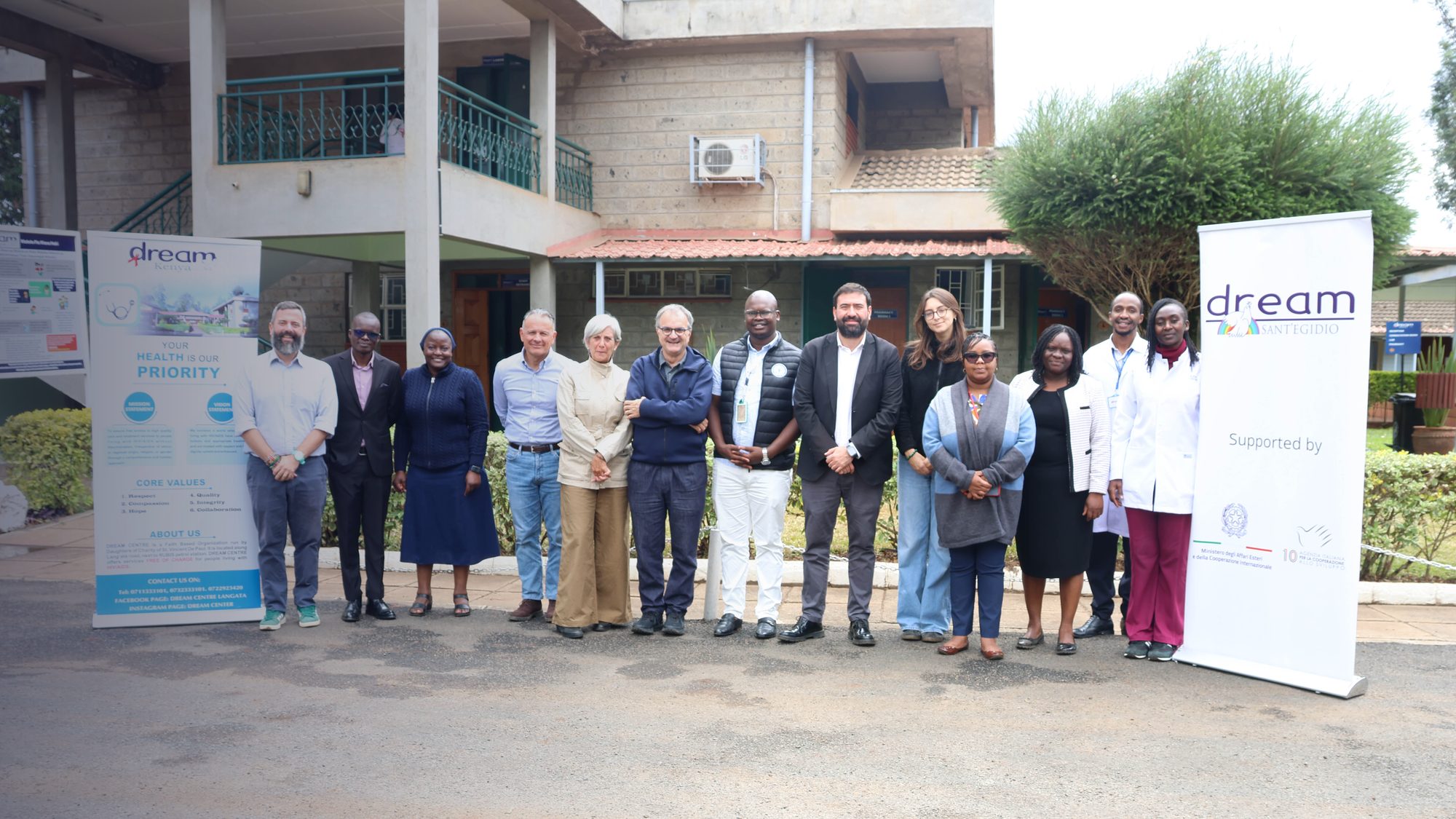
Kenya: “Beyond Siloed Care” launched, a new DREAM project supported by Italian Cooperation
A new project of the DREAM programme of the Community of Sant’Egidio has been launched in Kenya: “Beyond Siloed Care: strengthening the integration of HIV, TB and NCD services for people living with HIV in the community and local health system”. The project is funded by the Italian Ministry of Foreign Affairs and International Cooperation (MAECI) through the Italian Agency for Development Cooperation (AICS), as part of Italy’s 5% contribution to the Global Fund.
To mark the start of activities, a delegation of three representatives from AICS, from its headquarters in Rome and from the Nairobi office, spent several days in the country. The delegation visited the DREAM centres in Chaaria and Aina in Meru County, Chiakariga in Tharaka-Nithi County, and Nairobi. At each centre, the delegation toured the laboratory and the clinic, met with local health authorities and attended a presentation of the activities.
The new project builds on a twenty-year presence in the country. DREAM arrived in Kenya in December 2005, and over the years its network has expanded from rural to urban areas, with molecular biology laboratories that make on-site diagnosis and monitoring possible. “Beyond Siloed Care” is rooted in this experience, and in the relationships built with local health authorities.
Kenya has made significant progress against HIV: according to data from the Kenyan Ministry of Health, 96% of people living with the virus today know their status, and the large majority are on treatment. Yet this very success has changed the nature of the problem. Those in treatment live longer, and as they age they also develop other conditions: diabetes, hypertension, cardiovascular disease. Tuberculosis adds to the picture, remaining the leading cause of death among immunocompromised people: nearly one in four people diagnosed with TB is co-infected with HIV.
The result is that a single person needs three different kinds of care. The problem is that, in practice, these are three separate pathways: different clinics, different days, sometimes different facilities. For people living in rural areas, where reaching a health centre can take hours on foot, this often means choosing which illness to treat. And too often, it means dropping out of care altogether.
Those most at risk are adolescent girls and young women, who account for a share of new infections far greater than their share of the population, together with older adults, people with disabilities, and survivors of gender-based violence.
This is where “Beyond Siloed Care” comes in. The three-year project will operate in Nairobi, Meru and Tharaka-Nithi counties, on two fronts, because the care pathway breaks down at two different points.
The first front is the community. Community health workers will be trained, consultation platforms with local leaders set up, and health campaigns rooted in the communities themselves developed. The goal is for people to reach the health centre, and for those who stop treatment to be found again.
The second front is the centres. Here the work focuses on staff training, with particular attention to disability and gender, on strengthening diagnostic capacity, and on introducing “one-stop shop” models, where HIV, tuberculosis and chronic diseases are addressed within a single pathway, in the same place and on the same day. The project also includes operational research, led by the University of Rome Tor Vergata, to generate evidence on integrated service models and share it with local health authorities.
The strategic location of the centres, the quality of services even in the most remote sites, the high level of digitalisation and the ability to carry out regular laboratory monitoring were among the aspects the delegation particularly appreciated, alongside the innovation introduced through telemedicine and advanced diagnostics. The delegation also valued DREAM’s strong roots in the country and its integration with public health services. In this spirit, the meetings between the Italian delegation, representatives of DREAM Kenya Trust and DREAM Sant’Egidio, and the health authorities of Meru and Tharaka-Nithi counties proved particularly fruitful, reaffirming the shared commitment to continue cooperating and sharing experiences.
Equally valuable was the testimony of the patients, who told the delegation how their lives had changed after meeting DREAM. Because the centre is not just a place where people receive a health service: it is a point of reference for the community.
This is where the desire to give back is born, and this is how experiences such as the expert clients take shape: people who were cared for by DREAM in the past and who today share their experience with other patients. A way of giving back to the community what one has received.
The project “Beyond Siloed Care: strengthening the integration of HIV, TB and NCD services for people living with HIV in the community and local health system” (AID 012596/03/5) is funded by the Italian Ministry of Foreign Affairs and International Cooperation (MAECI) through the Italian Agency for Development Cooperation (AICS), as part of Italy’s 5% contribution to the Global Fund. It is implemented by the Community of Sant’Egidio ACAP APS, together with DREAM Kenya Trust and the University of Rome Tor Vergata.